
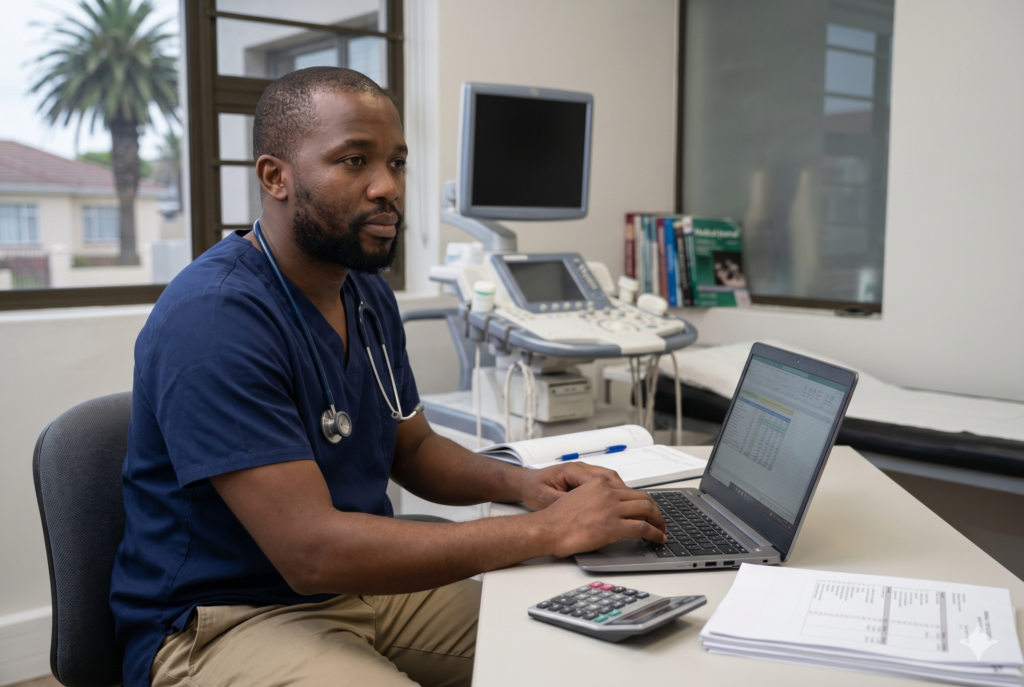
Minimising tax liability requires a systematic application of the Income Tax Act, not guesswork. The most effective deductions for medical professionals’ centre on professional costs, asset depreciation (wear and tear), and accurately apportioned operational expenses like vehicle and home office use. Structuring your practice correctly and understanding the distinction between deductions and credits are foundational to tax efficiency.
Professional Fees & Regulatory Subscriptions (HPCSA & Societies)
All costs associated with maintaining your professional standing are fully tax deductible for doctors operating their own practice.
- HPCSA & Professional Subscriptions: Annual HPCSA registration fees, society memberships, and medical journal subscriptions are legitimate business expenses, as they are essential for practising and fulfilling CPD requirements.
- “In Production of Income” Rule: These expenses are deductible because they are incurred directly in generating income for independent practitioners. However, they are generally not deductible for salaried doctors in formal employment.
We ensure you maximise these deductions while remaining fully compliant with SARS rules.
Protecting Your Practice: Professional Indemnity Insurance
Professional indemnity insurance (malpractice cover) is a critical and fully tax-deductible business expense for medical practitioners in South Africa. The premiums qualify as a necessary cost incurred in the production of income, as they protect your practice against claims of negligence, error, or omission. You can claim the full annual premium under “Insurance” expenses in your ITR12 tax return.
It is important to distinguish between business and personal insurance. Only premiums for professional indemnity cover are deductible. Personal policies such as life cover or income protection are not tax-deductible, although their payouts are usually tax-free.
Essential Medical Equipment & Wear and Tear Allowances
Acquiring essential medical equipment requires significant capital investment. SARS allows you to claim wear and tear allowances under Section 11(e) of the Income Tax Act instead of deducting the full cost in the year of purchase.
- Wear and Tear Allowance: You can deduct the depreciated value of equipment over its useful life as prescribed by SARS (e.g. MRI scanners over 5 years, computer tablets over 2 years). Assets used partly for private purposes must be apportioned.
- Low-Value Assets: Any individual item costing less than R7,000 can be written off in full in the year it is brought into use.
- Second-Hand Equipment: Used assets are depreciated over their remaining expected useful life based on conditions.
Proper record-keeping of purchase details allows you to maximise these deductions and effectively reduce your taxable income.
Navigating Vehicle Expenses: The SARS Logbook Requirement
Medical practitioners can claim vehicle expenses for business travel, such as visiting hospitals, locum work, or travelling between practice locations. However, commuting between home and your primary workplace is considered private and is not deductible.
To successfully claim business travel, you must maintain a detailed SARS-compliant logbook recording the date, kilometres travelled, and purpose of each business trip. At the start and end of each tax year, record your vehicle’s odometer readings to calculate the business kilometre ratio, which is then applied to all vehicle costs (fuel, maintenance, insurance, and wear and tear). Without a proper logbook, your claim will likely be rejected.
Home Office Deductions for Private Practitioners and Locums
Medical practitioners who operate from home or use a dedicated space exclusively for work can claim a portion of home expenses as a tax deduction. To qualify, the home office must be used regularly and exclusively for business purposes. For salaried practitioners, more than 50% of duties must be performed in the home office. This deduction is especially useful for private practitioners and full-time locums who handle administration, billing, and virtual consultations from home.
Calculating and Claiming Home Office Costs
The deductible amount is calculated on a pro-rata basis. You must determine the square-metre area of your office as a percentage of your home’s total area. This percentage can then be applied to qualifying expenses. These expenses typically include:
- Rates and taxes
- Cleaning costs
- Electricity and water
- Repairs to the premises
Rent or interest on your mortgage bond (note: as of 2023, interest on mortgage bonds is no longer deductible for employees in this context). Claiming this deduction can have Capital Gains Tax implications when you sell your primary residence, so professional advice is recommended to weigh the benefits.
Business Structure: Should You Practice as a Sole Prop or Inc.?
Choosing the right business structure is one of the most important decisions for medical practitioners in South Africa, as it has major tax implications. You can operate as a Sole Proprietorship, where the business and owner are the same legal entity and profits are taxed at personal income tax rates (18% to 45%), or as an Incorporated (Inc.) company, a separate legal entity taxed at a flat 27% corporate rate, with the doctor drawing a salary.
For lower to medium-income earners, a sole proprietorship is often more tax-efficient. However, high-income practitioners usually benefit more from an Inc. structure due to the lower corporate tax rate and greater flexibility for tax planning through retained profits and dividends.
Understanding Tax Credits: MTC vs. AMTC Explained
It is important to understand that a tax deduction reduces your taxable income, while a tax credit directly reduces the tax you owe to SARS. South Africa offers two key medical tax credits: the Medical Scheme Fees Tax Credit (MTC) and the Additional Medical Expenses Tax Credit (AMTC).
The MTC provides a fixed monthly rebate for contributions to a registered medical aid scheme for the main member and dependants. The AMTC offers additional relief for qualifying out-of-pocket medical expenses not covered by your medical scheme (such as practitioner fees, hospital costs, and prescribed medicine). The AMTC calculation is more favourable for taxpayers aged 65 or older or with a disability.
Solutions with Apex Pro Accountants
Our methodologies are engineered for financial accuracy and full SARS compliance. We provide solutions that address the specific operational realities of medical practitioners in the South African market. A professional consultation is the most direct path to ensuring every claim is substantiated, and your tax liability is minimised within the legal framework. Get a quote using the button below.
FAQs
Are my HPCSA registration fees and medical journal subscriptions tax-deductible?
Yes, if you are an independent practitioner running your own practice, fees for HPCSA registration, medical society memberships, and journal subscriptions are considered operational expenses incurred in the production of income and are fully deductible.
Can I claim for travel between my home and the hospital?
No, travel between your home and your primary place of work is classified as private travel by SARS and cannot be claimed. You can only claim business-related travel, such as trips between multiple practice locations or to different hospitals for patient rounds.
How do I claim for expensive medical equipment like ultrasound machines or stethoscopes?
Expensive equipment is claimed via a wear and tear allowance, which depreciates the asset value over its expected useful life according to SARS schedules. Smaller items costing less than R7,000, such as a stethoscope, can be written off in full in the year of purchase.
What is the difference between a tax deduction and a medical tax credit in South Africa?
A tax deduction reduces your total taxable income, lowering the amount on which your tax is calculated. A medical tax credit is a rebate that directly reduces the final tax amount you owe to SARS, providing Rand-for-Rand savings.